

Description:
Libraries and archives safeguard collective memory, preserving written cultural heritage. Together with museums and galleries, they protect artifacts of historical and artistic significance, showcasing humanity’s evolution and achievements.
However, climate change increasingly threatens these collections. Extreme temperatures, heavy rainfall, and high relative humidity challenge the infrastructure of archives and libraries, making it difficult to maintain proper storage conditions. Materials like paper, parchment, and vinyl require specific long-term conditions, including controlled temperature (T) and relative humidity (RH). Without these, artifacts are vulnerable to mechanical, chemical, and biological degradation.
This research aligns with standards PAS 198:2012 and EN 16893:2018, which emphasize controlling T, RH, and pollutants according to institutional preservation policies. While pollutants play a minor role in paper degradation compared to T, effective environmental management in libraries and archives must focus on T and RH.
Libraries and archives must also adapt to energy efficiency requirements, addressing their entire life cycle, including use, maintenance, demolition, and recycling, to ensure environmental sustainability. This presents a challenge for heritage institutions with limited budgets, which need to reduce energy costs while protecting collections.
In Slovenia, addressing this issue has become urgent. Ensuring suitable indoor storage conditions, alongside digitization efforts, demands significant resources, staff training, and innovative solutions. Current environmental standards alleviate concerns that prescribed conditions could prevent adopting climate-friendly practices. The MitiClim project addresses this need, balancing effective preservation with reduced carbon emissions.
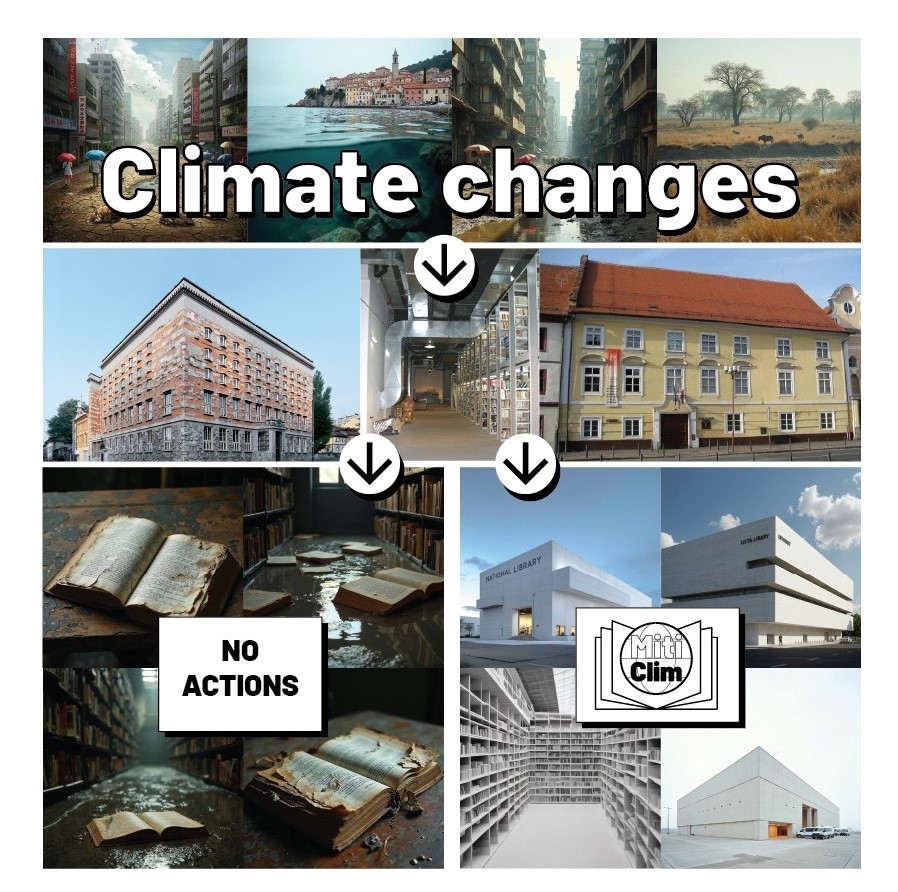
Graphical abstract of the MitiClim project
The project aims to model the effects of storage solutions supported by passive design strategies under varying T and RH conditions and assess their impact on preserving library and archival materials.
Key objectives include:
O1: Evaluating existing storage at the National and University Library that does not meet current standards.
O2: Developing a model repository with passive climate control and passive design strategies.
O3: Creating a renovation model for historic storage facilities using passive design strategies.
O4: Assessing these models for preserving Slovenia’s core written heritage, Slovenika.
Sustainable storage solutions will be modelled through:
- Building modelling
- Collection modelling
- Mitigation strategy modelling
The assessment will use a sustainability analysis tool combining Life Cycle Assessment (LCA), Life Cycle Costing (LCC), and Social Life Cycle Assessment (S-LCA) to evaluate social, environmental, and resource priorities.
The project’s outcomes include:
- 3D dynamic visualizations of T, RH, and surface conditions in repositories.
- 2D visualizations of surface mould growth under varying conditions.
- Demonstration of innovative mortars for passive T control.
- LCA and LCC analyses for different storage models.
- S-LCA for long-term preservation planning (up to 500 years).
- Guidelines for environmentally sustainable preservation and T/RH regulation in Slovenian storage facilities.
Impact:
The outcome of proposed project will lead to a significant optimisation of environmental management as well as assist in the process of building planning and refurbishment in libraries and archives in Slovenia and abroad.
Partnership:
MitiClim (J7-70270) is a three-year project starting on 1 March 2026, funded by the Slovenian Research and Innovation Agency (ARIS) with a total budget of €434K. The project involves key Slovenian institutions:
National and university library (NUK, Coordinator: dr. Jasna Malešič)
Slovenian National Building and Civil Engineering Institute (ZAG, Lead: Alen Hausmeister)
Heritage Science Lab Ljubljana (HSLL), Faculty of Chemistry and Chemical Technology, University of Ljubljana (HSLL, Lead: Prof Dr Matija Strlič)
Institute for the protection of cultural heritage of Slovenia (ZVKDS, Lead: Dr Klara Retko)
