

Doctoral student Emma Paolin with colleagues from the Heritage Science Laboratory Ljubljana and the National Museum of Slovenia (NMS) have published a new study evaluating non-invasive sampling devices for heritage objects. The research compared the recently developed HiSorb probes with sorbent tubes filled with Tenax TA® for determining volatile organic compounds (VOCs).
The approach was applied to two snuffboxes: a reference snuffbox still containing tobacco from the reference collection of the Heritage Science Laboratory Ljubljana, and a historical snuffbox from NMS that previously belonged to the Slovenian poet France Prešeren.
Both methods successfully identified the main VOC emissions, but the HiSorb probes detected tobacco-specific components, such as nicotine and pyridine. This advantage is likely due to their compact size, as the probes were placed directly inside the small cases, unlike the sorbent tubes, which collected the headspace in a 3 L reactor.
Further tests focusing on olfactory analysis confirmed that HiSorb probes are suitable for this type of analysis, revealing a rich profile comparable to traditional sorbent tubes used for the same purpose. The main descriptors detected for both snuffboxes were “wood”, “leather”, “flower”, and “fresh”.
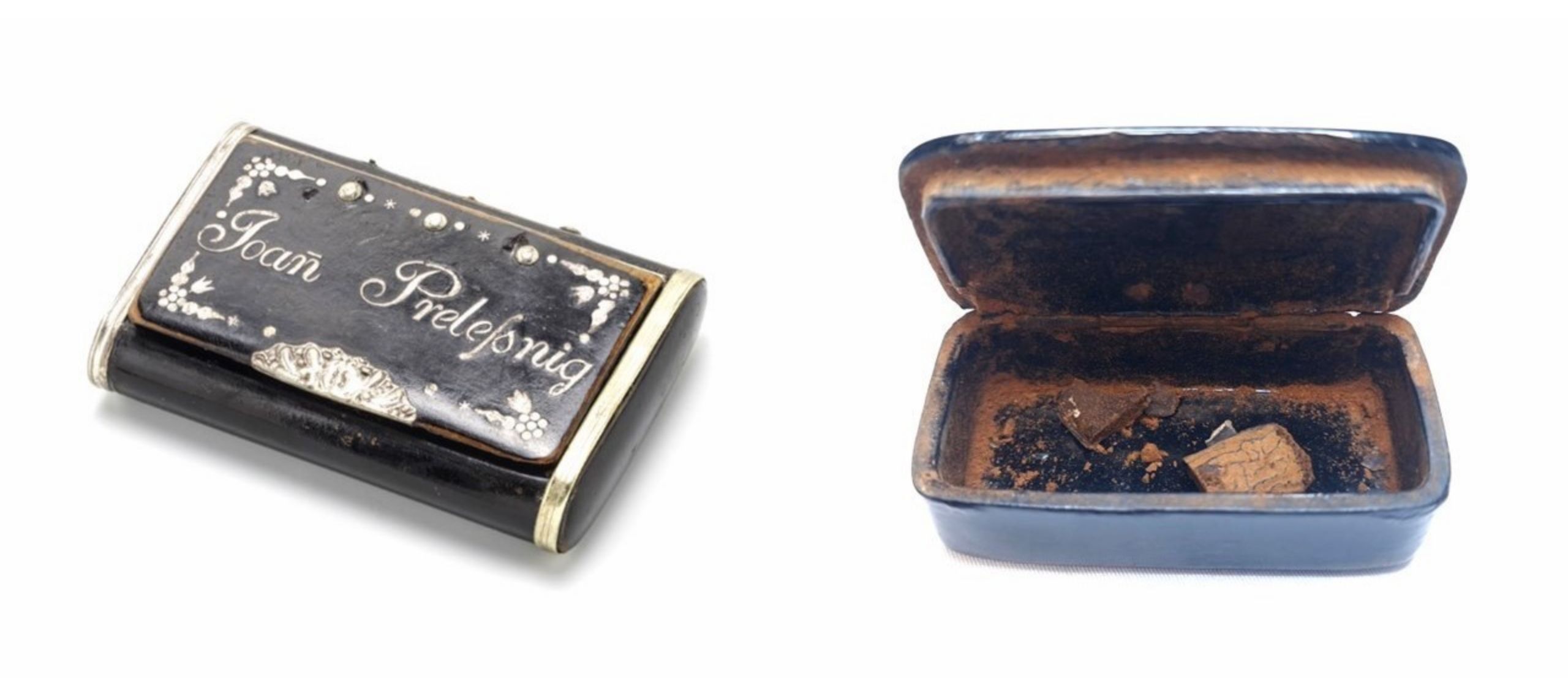
The two snuffboxes studied in the research. On the left the museum snuffbox (photo by Tomaž Lauko, National Museum of Slovenia), and on the right the reference one, as used in this research.
