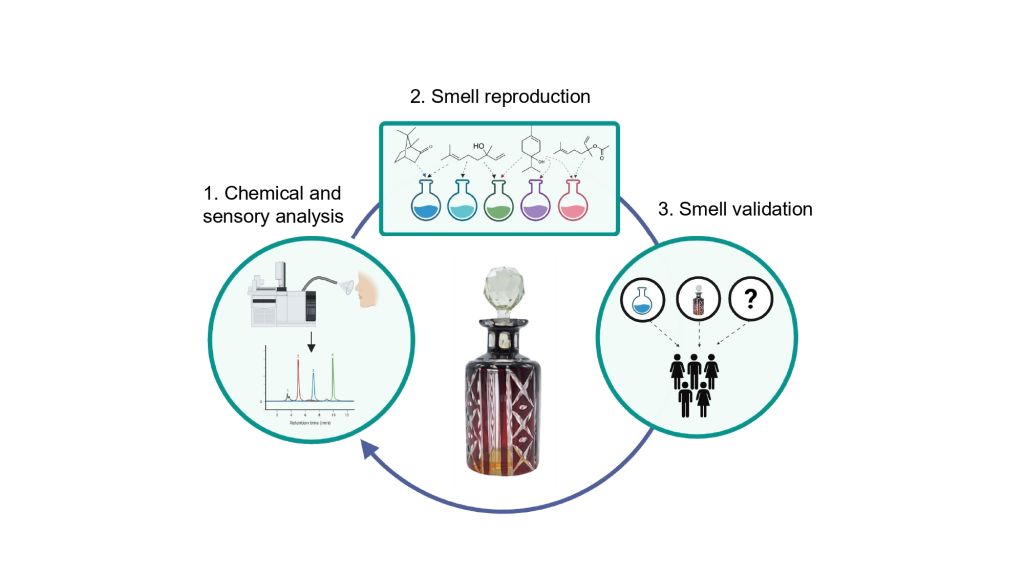
Doctoral student Emma Paolin, together with colleagues from the Heritage Science Laboratory Ljubljana, has published a new study on reproducing the smell of historical objects. The research evaluated every step of the process, from sampling, through chemical and olfactory characterisation, to reproduction and validation, using an early 20th-century perfume flask as the case study.
The aim was to reproduce the current smell rather than the original perfume formulation, establishing a methodology transferable to other heritage objects. The methodology combines traditional gas chromatography–mass spectrometry with olfactory detection (GC–MS/O), enabling the determination of the odour-active compounds responsible for the object’s olfactory profile. By determining odour activity values (OAVs), compounds were ranked based on their sensory impact, and 13 compounds were selected as significant for the olfactory profile. Final validation involved chemical analysis, omission tests, and sensory assessment by a panel (n = 70) comprising trained and untrained panellists. Statistical analysis confirmed no significant difference between the original perfume and the reproduction.