

Description:
Inks used on papyri and paper manuscripts represent an interesting underexplored archaeological and heritage resource that establishes a link between ancient Egyptian, Roman and later Islamic civilisations and Europe. The technology of production of Iron Gall Ink (IGI), primarily composed of iron sulfate (vitriol), gallotannins and binders, remains a significant concern requiring long overdue in-depth research as the evolution of manufacturing across different time periods and regions reflects local resources and technologies as well as regional trade which may affect the inherent instability of the ink. The earliest recorded use of metallo-tannic inks in Pharaonic Egypt and their continued use in the Islamic era may provide a narrative that transcends the traditional cultural and temporal boundaries. In contrast to the extraordinary importance of this written source, we know very little about the characterisation, authentication, historical timeline, interpretation and continuity of material history and material evidence represented by the large global collections of inked papyri and paper from ancient Egypt to Islamic periods in EU GLAMs (galleries, libraries, archives and museums).
The pronounced interdisciplinary nature of TRACE-INK will set a new paradigm in archaeometry and conservation research by bringing together leading academic experts from the fields of archaeology, history, chemistry, and heritage science to trace the production of IGI and reconstruct its chronological scale. TRACE-INK will provide the so far elusive knowledge of the distribution of IGI components in papyrus and paper by developing a best practice for understanding the origins and changes in manufacture and characterize the role of different additive dyes in IGI-support degradation. The project will address this key knowledge gap by harnessing the power of its SSH and STEM approach combining archaeological, archival and historical research and objects survey with spectroscopic and chemical imaging and analytical techniques [such as Hyperspectral Imaging (HSI), Desorption Electrospray Ionization-Mass Spectroscopy (DESI-MS), and Secondary Ion Mass Spectrometry (SIMS), X-ray Photoelectron Spectroscopy (XPS), Near Infrared Spectroscopy (NIR), and Raman & X-ray Fluorescence Spectroscopy (XRF)] to bring new knowledge of the molecular structures of IGIs on papyrus and paper supports from collections in Slovenia and Egypt. This is crucial for characterising material history/timelines, verifying authenticity, understanding historical, and informing conservation and research into archaeological heritage. This project will develop imaging and analytical methods for successful analysis and visualization of IGIs, as well as of the chemical stability of the inks and cellulosic support materials.
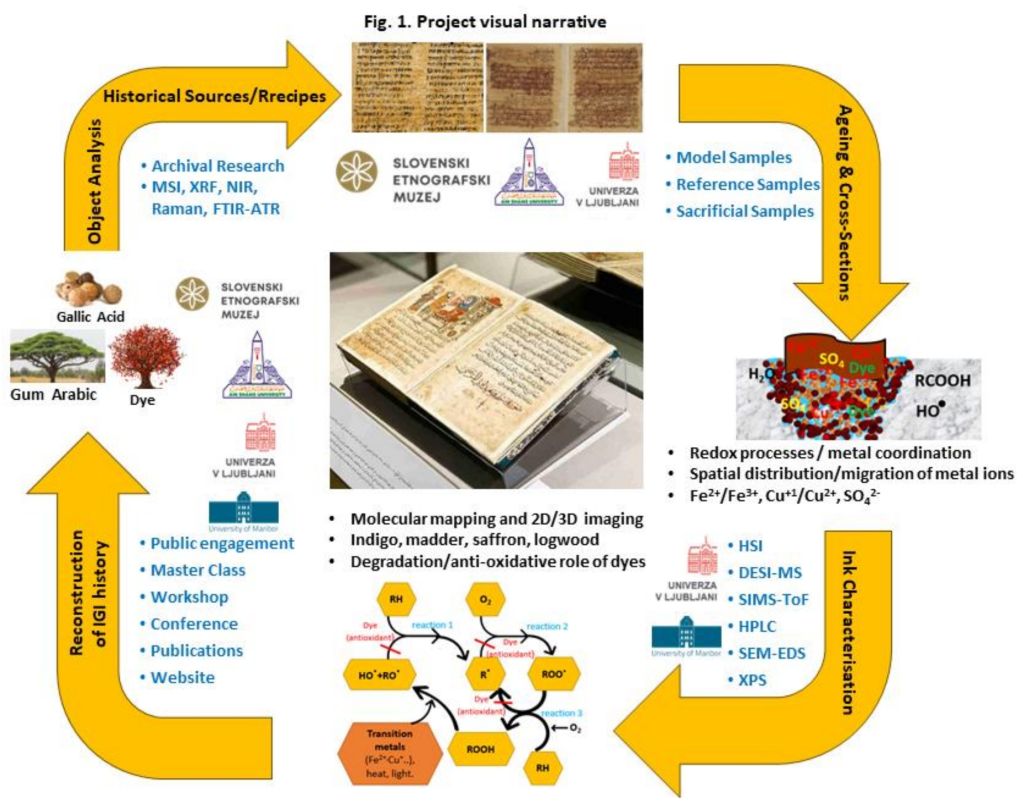
TRACE-INK brings together leading academic experts in conservation, archaeological, analytical and heritage sciences. By leveraging decades of experience in the study of heritage materials, this project will develop new methods of analysis of IGIs using advanced microanalytical and surface analysis techniques followed by dedicated dissemination, training, and public engagement events. While model samples will be produced based on archival research, well dated archaeological and historical inked papyrus and paper samples and case studies will be obtained from historical collections of the partners (UL, SEM, EMC, ASU).
A portable lab of non-invasive techniques such as Multispectral Imaging (MSI), NIR, Fourier-Transform Infrared (FTIR), Raman and XRF Spectrometers will be used for the investigation of archaeological objects in Slovenia and Egypt to trace the use of IGIs in ancient Egypt and Islamic eras subsequent by in-depth analysis using several techniques. HSI, DESI-MS, XPS and SIMS will be used on ion-beam-cut cross-sections of both model ink applications and sacrificial historical samples to provide detailed, spatially-resolved and stratigraphic characterization of metals and their oxidation states using and give us unprecedented insight into the evolution of the processes leading to the frequently observed differences in the states of preservation of historic IGI.
The teams at the University of Ljubljana and the Laboratory for Analytical Chemistry and Industrial Analysis at the University of Maribor (UM), in collaboration with egyptologists, archaeologists, conservators and scientists from the Slovenian Ethnographic Museum and the Ain Shams University, will perform the following studies:
(i) archaeological and archival research for understanding the history and technology of production of IGI and selection of inked papyri and paper manuscripts case studies from ancient Egypt, Graeco-Roman, and Islamic periods where the first use of IGI and the written evidence have become obscured due to degradation and loss;
(ii) research into visualisation of faded and degraded written evidence and tracing the use of IGI on ancient papyrus and historical paper collections using a non-invasive mobile lab methods such as multispectral imaging, NIR, and XRF;
(iii) research into the redox processes, metal coordination, and ink constituent migration using 2D and 3D imaging and chemical mapping using fixed lab to understand the role of metals and dyes in ink oxidative decay and migration will enable better and urgently needed scientific knowledge necessary for improved manuscript preservation.
Objectives:
Trace-Ink aims to provide entirely new insight into IGI identification, degradation mechanisms, and their dating. This information will enable document authentication, conservation, and new insights into the history of ink. This is an ambitious project, yet entirely realistic due to the already available expertise in the project team, consisting of groups with a long history of collaboration.
To achieve this, the project has the following set of objectives:
- To perform in-depth archival research and object analysis to trace the chronological scale of IGI to develop an understanding of its origins and changes in manufacture.
- To characterize IGIs components and small amounts of additive dyes with composition/3D distribution and their evolution in time and role in heterogeneous degradation based on model samples and real cases studies.
- To develop and disseminate imaging and microanalytical analysis techniques for reconstruction of IGI use in the ancient Egyptian and Islamic manuscript culture, and to ensure method inclusion in E-RIHS.
Impact:
TRACE-INK will be groundbreaking not only in Slovenia and Egypt, but also on a global scale with a substantial contribution to the broader understanding and preservation of documentary heritage on papyri and paper collections in global GLAMs. Optimised imaging and analytical techniques will improve technologies and better services and products can be offered not only to the heritage domain, but also to a wider audience through a collaboration between curators and conservators. The improved understanding of the public’s approach to archaeological and recent heritage will lead to an improved quality of life. Improved management of heritage collections will have an impact on the sustainability of tourism, which is one of the major economic drivers.
Partnership:
Trace-Ink (J6-70228) is a three-year project starting on 1 March 2026, funded by the Slovenian Research and Innovation Agency (ARIS) with a total budget of €300K. The project involves key Slovenian and Egyptian institutions:
- Heritage Science Lab Ljubljana (HSLL), Faculty of Chemistry and Chemical Technology, University of Ljubljana (Coordinator: Dr Abdelrazek Elnaggar)
- Slovene Ethnographic Museum– SEM (Lead: Dr Marko Frelih)
- Laboratory for Analytical Chemistry and Industrial Analysis, University of Maribor (Lead: Dr Matjaž Finšgar).
- Faculty of Archaeology, Ain Shams University (Egypt) – (Collaborators: Dr Hassan Ebeid, Dr Ahmed Nakshara, and Dr Mamdouh Eldamaty)
- Egyptian Museum in Cairo (EMC), Egypt – (Collaborator: Dr Ali Abdelhalim)
